Is Storytelling Professional or Manipulative?

rachel's mom

This week in class, we learned about the art of storytelling and how we can utilize this in social media to market a brand or start a movement. Is storytelling ethical in the workplace, or is it manipulative to use emotions to appeal to people?

According to strategic communication expert Susan Fisher, people don’t tell stories enough at work in order to seem more professional, but we still need to consider the impact of what authentic storytelling can do. Susan Fisher states: “It’s because they have been taught that at work you use logic and slides and statistics; this seems more professional. Telling stories seems too emotional and possibly manipulative. So people stick to facts and numbers. But the truth is that real emotions always work better, because that is the way to reach hearts and minds, and also people get to see the real you. It’s authentic.” A good story is short, has a takeaway message, and displays a conflict or question that reaches a resolution like in a movie. If we can effectively utilize these basic tools of good storytelling, we can use stories for almost anything in order to reach both the minds and hearts of our clientele.  

For example, one of the most famous and viral charity movements in the last decade started because of a tragic story that turned into a beautiful triumph. Outliving our children is a classic worst nightmare. On July 23, 2011, a nine-year-old girl named Rachel Beckwith died in a car accident outside of Seattle only one month after her ninth birthday. On her birthday, she had dedicated it to raising money so that 15 people in a third-world country could drink clean water. Her goal was $300, but she only reached $220. When she died, her story went viral. This sparked a huge movement for “Charity: Water”, which ended up being able to bring clean water to 37,700 people in Ethiopia due to the impact of Rachel’s story all over the internet and news. What was so moving about her story is that it took a great tragedy and turned it into something that would make an infinite, lasting memory as well as an impetus to help others and create awareness about the water crisis in other countries around the world. It isn’t always common to see people have such big hearts and actually try to make a difference in the world, so knowing that there was a child who gave up her birthday to donate money to help others who were struggling is deeply moving and allows us to keep her memory alive long after her own life was tragically cut short.

While it may be a controversial topic, I believe that it is ethical to use stories like Rachel’s to gain the attention of people who were previously unable to see outside their provincial lives and realize that they could be heroes and make a true difference. The thing that really impacted Rachel’s movement was that it wasn’t just all about her, but rather that she represented empathy and generosity for others. According to Donne Torr, there is a lot to learn from this type of marketing. In her blog post on Hootsuite on May 2, 2014, Torr discusses the digital media company called VICE, who has had tremendous success as a media organization due to effective storytelling. One of Torr’s main points is that VICE creates stories on social media that display authenticity and humility because the stories are about the people they encounter in their world travels. What we can take away from companies like VICE and Charity: Water is that, if you can effectively tell stories that make your audience feel like the hero, it empowers people to participate in a cause and choose to represent your brand. This is an incredibly powerful tool and something that we should consider as we represent ourselves, our companies, and whatever brands we believe in through social media.   

What is Mythic Plus (M+) and why should you care?

kjell

When you think of World of Warcraft, does it remind you of sleepless nights, energy drinks, and LAN parties with your high school friends? Does it make you think about 4+ hour raid nights multiple days a week with a group of 20+ friends in Ventrilo working together to defeat the most challenging end-game bosses? Does it remind of the old glory days of your childhood but also feel too daunting because it was almost like an unpaid full-time job?

World of Warcraft (WoW) was first released by Blizzard Entertainment on November 23, 2004 and has continued to dominate the Massively Multiplayer Online Role Playing Game (MMORPG) market ever since. Many new MMORPG games have come out over the years and tried desperately to mimic or surpass WoW, yet WoW has managed to maintain its foothold as the dominant force in the genre. How does an older game continue to keep fans hooked despite newer games coming out every year that look flashier, better developed, and that promise fans superior modern content?

The answer lies in WoW’s lasting influence on culture, society, ability to evolve, and the rapidly-growing competitive Esports scene for all video games. The newest addition of Mythic Plus (M+) dungeons in 2016 took what players loved about original WoW and gave it a modern spin to fit the limited time investment of adults in video games today. For a solid decade, the primary competitive scene of WoW was separated into two different realms of play: player versus player (PVP) and player versus environment (PVE) content. In PVP, players grind out their characters to make them as strong as possible with the best gear, stats, and talents and then compete in arena matches of 3v3 against other player teams that can take them to international tournaments with large cash prizes. In the PVE side of the game, players work together in guilds of 20+ people to kill challenging end-game bosses in raids that require large groups of different classes/specializations to kill. Everyone has to do their job and coordinate with each other, so when a boss gets killed, a group of 20 or more people celebrate their accomplishment. Guilds also compete against other guilds as to who kills all the endgame bosses in a raid tier the quickest, which can be tracked on external websites such as Wowprogress, but there has never been a large cash prize for PVE content in WoW.

Screenshot (2896)

All of this was extremely time-consuming and new games have hit the market such as Overwatch, Fortnite, and Player Unknown Battlegrounds that people can play competitively without spending countless hours grinding out silly quests in order to build up their individual characters. Now with M+ dungeons, players form teams of 5 people to compete in timed PVE instances that scale up in difficulty and change affixes every week in order to force players to work around serious obstacles while keeping the content fresh, new, and exciting. This past year, Blizzard Entertainment hosted an official Mythic Dungeon Invitational (MDI) tournament that was streamed live on Twitch where players from all over the world competed against the environment to beat the dungeons, but also against other teams of 5 players as to who could complete the dungeons quickest. This is the first PVE Esport of its kind and it is by far the most popular and successful feature of WoW that we have ever seen. At the end of the MDI, the winners were awarded $280,000 and a whole lot of glory and gaming sponsorships to go around.

Due to the explosive popularity of M+, droves of WoW veterans are subscribing back to the game to take part in the action. Esports are exploding all over the world, and Blizzard is aware that this is what people want to see, so WoW is now centering more and more around its new Esports scene of M+. According to Lisa D. Jenkins, successful companies are ones that adapt their social strategies around the people adapt their social strategies around the people. It had been a long-time complaint from WoW subscribers and veterans alike that people loved the social and competitive aspects of WoW but didn’t have enough time to invest. M+ dungeons are Blizzard’s way of evolving with the needs of their consumers as well as society. We live in a world where we need things fast and in smaller chunks in order to keep up with the rapid sharing of information through technology. The digital world never sleeps. We want to talk about things through social media and connect to people and organizations who share our interests. Some of the most popular video games across genres today are ones where people don’t need to invest a large chunk of time into it in order to enjoy the game or feel a sense of accomplishment.

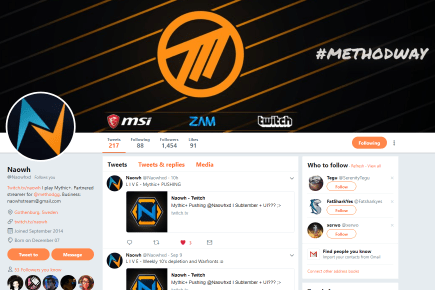
Screenshot (2900).pngPeople love M+ because they can do it in small chunks of time, but also because it is great content for self-promotion and streaming on platforms such as Twitch and for other social media such as YouTube, Instagram, Twitter, Reddit, Discord, and many others. Players can stream their content live and use it to connect to other players to learn new strategies to improve their gameplay. They can Tweet at each other and interact in Discord servers to flex their egos and/or learn tips and tricks. They can even track and compare their scores on Raider.io or compare parses with comprehesive tools such Warcraftlogs. M+ dungeons fit with social media because everyone wants to learn new things, compete against each other, and make unforgettable content on the things they are passionate about. This Esport has given people a new identity and community with which they are forming international reputations with social media profiles that are giving them employment and connections to people from around the globe.

In conclusion, if you miss WoW and love challenging yourself but you don’t much time to invest, try out M+ dungeons and see what all the hype is about. Who knows–you just might become a real-life hero from your own computer!

k

What the heck is a social media professional if everyone knows how to use Facebook?

AdobeStock_123821810_Preview

I’m sure you have heard the term “social media professional”. Maybe you’ve even been pressured into hiring one for your business. But what the heck is a social media professional? Doesn’t everyone know how to use Facebook and Twitter? Why shouldn’t you just have someone in-house take on the social media responsibilities of your business?

In short, there is no single answer to these questions. A social media professional is thought to be someone with a wide range of skills across relevant social media platforms that displays mastery of marketing strategies, customer service, and online hospitality in their digital footprint.  However, there are people who believe that there is no such thing as a social media professional. According to Peter Shankman , the term is meaningless and he’d never hire one. He argues that success in social media is derived from the same skill sets and talents that are possessed by professionals in marketing and customer service regardless of the new technologies brought about by this new digitally-dominated generation. Shankman posits that social media mastery is displayed by using transparency/honesty, the relevance of your products or services, brevity in your advertising, and knowing about your customer–all of which fall under the larger umbrella of marketing.

While I agree with Shankman that it is almost ridiculous to call someone a social media professional, I also agree with another school of thought proposed by Gary Vaynerchuk that it’s more important for a person to display compelling social media skills on their digital footprint rather than a perfect, traditional PDF resume listing off their degrees, jobs, and life achievements. To Vaynerchuk, it doesn’t matter if you graduated Harvard University with a masters in Communication or Marketing and he won’t even read your resume. Instead, it matters that he can search someone on Google to see if they display natural talent through how many relevant social media platforms they’ve mastered and how they interact online through their various social media profiles.

With the direction society is heading, I don’t think that a social media professional will be a real job title. I think that this field will meld back into the disciplines of Marketing and Communication, since social media is becoming a requirement for all businesses and public figures to use both corporately and personally to share ideas and connect with others all over the globe. 

Whether a person is educated at Harvard, a local community college, or a high school dropout, all social media professionals seem to share some key skills in common. According to Bailey Seybolt, there isn’t one secret recipe to becoming amazing at social media management, but the most important skills tend to include writing/editing, Search Engine Optimization (SEO), customer service, design and photo editing, analytics/reporting, video creation, paid social basics, and research/planning. The best part of all this is that you can be entirely self-taught and still achieve success as an influencer online. 

Whether we want to call someone a social media professional or a marketing expert, there is no question that social media has vast benefits for all organizations to the point that it is almost a requirement for success in business now. Social media builds brands and brand-building is one of the most powerful marketing tools that a business can have. This past week, I finally made my logo for my Twitch stream and have been putting it all over my social media. I have gotten a lot of great feedback and it feels great to finally have my very own brand, but some people have noted my logo’s resemblance to Warner Bros because it is the most famous two-letter logo within a shield symbol. What made me feel better was when one friend pointed out that, despite its slight similarity, my logo draws upon the famous iconography of the Warner Bros symbol yet is still unique enough to lend something special to me.

In a brand-driven world, it can be immensely beneficial for us to create our own brands and learn how to promote them through relevant social media platforms. I believe that it is important that we all establish our brands as a thought leaders, since people want to follow the people and organizations who change the way whole industries think and share ideas that open our minds to new possibilities in every facet of our lives. However, it’s not all about these traditional marketing skills. If we aren’t also savvy on the most relevant social media platforms and are simply good writers, communicators, or marketers, then we are missing some really big opportunities for growth.

In conclusion, I don’t think that there is a specific set of skills for a social media manager because there has never been only one right way to treat marketing or customer service. Every organization has its individual needs, so it is important that people strive to apply talent, hard-work, research, creativity, and open-mindedness to every endeavor whether it be a simple Tweet on Twitter, a daily Facebook post, or a live-stream on Twitch. Arguing over the legitimacy of a title called “social media professional” seems as trivial as the age-old “tomato tomato, potato potato” pronunciation debate. Whether we call it marketing or social media, it’s all relevant and it’s all worthy of our awareness. My best advice is to stay open to possibilities and learn new platforms/technologies, but always remember that there are many roads we can take to achieve success through our social media. Everyone is different and the possibilities are limitless!